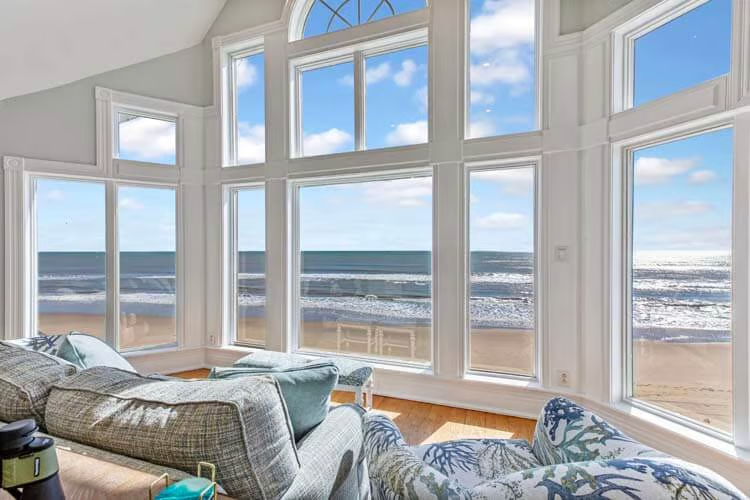
1. Decide on the intended use.
Do you want your Outer Banks home to function as a primary residence, a second home or a vacation rental investment? Your answer to that question will guide literally every single step from here, from the home’s location to the features to the financing.
If you don’t plan to rent the home, or if you plan to use it as a primary residence, then the home search is guided by what you might expect: your family needs, preferences and budget.
If you plan to use the home for a dual purpose - balancing your family vacations with rentability - your search will also be guided by factors that increase a home’s rental income potential. For example, bedroom count typically plays a bigger role in rental income generation than square footage, so you might find yourself passing on that updated 2500 sqft 3 bedroom home in favor of the more modestly appointed 4 bedroom 2000 sqft home with a pool.
Some Outer Banks buyers are strict investors buyers, they purchase solely to capitalize on the equity gain and tax advantages that our vacation rental market provides, with no intent to use it for themselves. For these buyers, the path is in the math, finding the home that generates the most rental income with the least expense. For these buyers, items of importance in a home will be proximity to beach access, bedroom count, amenities like pool or elevator, age of the major systems like HVAC and windows, and a solid understanding of the yearly expenses.
It’s essential to understand where you fall on the usage spectrum - and convey that to your Outer Banks realtor - so that you can focus on the home and location aspects that best suit your goals.
2. Talk to a LOCAL Outer Banks lender.
The Outer Banks real estate market is very different than almost all other markets because the majority of our homes are not used as primary residences. They are second homes in property management programs that generate vacation rental income. I cannot emphasize how much that matters when it comes to financing, and that’s why it’s so valuable to use a local Outer Banks lender. They deal with second home and investment funding every single day, it IS their primary market.
Contract attachments like a Vacation Rental Addendum or Bill of Sale, for example, are rarely attached to primary home purchase contracts, but are almost always factors in an Outer Banks investment home purchase. And they are giant (and expensive) road blocks when lenders (or out-of-area realtors) are unfamiliar with them.
Not only that, but appraisal costs can be higher and have more conditions, quoted mortgage rates can be inaccurate because the big-box lender didn’t factor in the vacation rental addendum (b/c they don’t know it exists) and last minute delays are much more common.
Other than hiring a skilled local realtor, the biggest tip that I can give any prospective buyer is to talk to a reputable Outer Banks lender. I promise that it will save you time, money and hassle. And in some cases, it can cost you the deal if you don’t.
3. Consider the value of sand.
A common phrase you’ll hear on the Outer Banks is that “our sand is expensive.” What we mean is that the geographical area referred to as the Outer Banks is essentially a sandbar in the middle of the ocean. The closer a home is on that sandbar to the ocean, typically the more value there is in “the sand” upon which it was constructed, and that is reflected in its market value. In some cases, that “sand value” makes up the majority of the total assessed value of the home.
Traditional ways to determine home value that work in primary residence markets - like price per square foot comparisons - don’t always work here because of the extreme value difference in lot value. The value of a home on the oceanfront will be much higher than the value of the exact same home just one lot back from the beach. Go another lot back and there’s an even bigger value difference.
That’s also why Zillow zestimate ranges for Outer Banks homes are so wide and can arguably be misleading, because they use a radius-based comparison tool when zestimating a home’s value. That type of value calculation might work for primary markets where the lot value of neighboring homes is similar, but doesn’t translate when comparing homes on the Outer Banks where neighboring lot values differ by hundreds of thousands of dollars.
The location relative to the oceanfront also effects rental income potential of a home, and since we’re an investment-heavy 2nd home market, the income potential can be a big factor in a home’s current or future value
Understanding the unique factors that go into the value proposition of an outer banks home will help you make the best purchase decision, and also give you a more realistic expectation of what homes look like in different price points.
4. Plan a visit.
Whether you’ve never been to the Outer Banks before or whether you’re a frequent vacationer who’s now considering a home purchase, planning a pre-purchase trip to the Outer Banks is the best thing you can do to position yourself advantageously in this market, and save you time in the long run.
You only need a weekend, and sometimes even just a day to two. Drive around to the different towns and neighborhoods, view homes with your realtor along the way. Take in the character of the town and surrounding homes, the pros and cons of each location, and get an idea of the type of home you get for the money.
It’s unlikely that you find your dream home on this one trip. What’s more likely is that you and your realtor will have a much better idea of what you want in a home and where you want it. I can almost guarantee that what you thought you wanted before you took the trip will end up being different than what you really want, that’s just how it goes and why this step is so important.
5. Leverage your realtor.
You’ve determined your home usage goals, you’ve talked to a lender, you’ve got a handle on Outer Banks home values, you’ve taken a long weekend to visit in person and now you are clear on what you want and your budget (and so is your realtor). You’ve likely made it back home from your Outer Banks visit, excited, a little overwhelmed, but with much more clarity on your ideal home. Now what?
Now you and your realtor work together to watch the market until the right property comes available, because congratulations, you’ve set yourself up for success and to be ready to pounce when the right home comes onto the market.
This is also a great time to do more homework. Have conversations with your realtor about the offer process and review the paperwork so you’re ready when the time comes. Leverage their professional rolodex of service providers, like insurance agents, property managers, and service providers.
As an Outer Banks realtor, when I have clients in this stage, video tours are a great tool. If we see a home with potential come onto the market, I’ll go walk thru the home and take a video tour or FaceTime them. That lets them “see” the home immediately, versus waiting for weeks before their schedule allows them to make a trip, which in many cases can cost them the deal. It can be a time saver for them if the home turns out to be a dud OR it can put them in a position to immediately make an offer.
Use this time to do prep work for your financing. Work with your lender to get a list of documents they’ll need. Some buyers need to liquidate market assets or retirement funds in order to complete a purchase, and this gives them time to get those processes started. You’ll be surprised what a knowledgeable lender can come up with as far as ways to get you the best product and rate and sometimes that means creative ideas that take some planning.
The more you can learn and prepare now, the better position you’ll be in when the right property comes available.
Whether it’s in real estate, business or life, some of the most lucrative opportunities happen by being in the right place at the right time. And being “there" at “that time” isn’t always a lucky coincidence, sometimes it’s a result of calculated planning. If you follow these 5 steps, you’ll be in a much better position to recognize one of these opportunities and capture it, when it presents itself.